MARIA ALBERTO TORRES

It may seem to an unsuspecting observer that Maria Alberto Torres, the eldest of the children of the jurist and politician Alberto Torres, was throughout her life simply the “faithful squire” of her more famous sister, the anthropologist Heloísa Alberto Torres. In fact, the two worked and lived together, single and independent women who fought for their goals at a time of declared machism. However, their paths in public service were not always, and Dona Marieta, as she was known, had her own brilliance.
Born in Niterói on August 19, 1892, Maria Alberto Torres was the daughter of the then rising politician Alberto Torres, who would later become governor of the state of Rio de Janeiro and minister of the Supreme Court, and Maria José Xavier da Silveira, from a traditional family from São Paulo. He began his education at Jackson College, in Rio de Janeiro and later, when his father moved to the then state capital, Petrópolis, studied at Notre-Dame de Sion College.
Her upbringing in a traditional Catholic school influenced Marieta's life, one of the main pillars of which was her faith. Among the many clubs and organizations with which she was associated, the Associação Cristã de Moços (Young Men's Christian Association) and the Institute of Religious Culture - SP. Together with her sister, she collected religious items, such as oratories and sacred images, which are part of the collection of the Casa of Culture Heloísa Alberto Torres, in Itaboraí.
Among the various positions he held in the federal administration, in which she joined in 1921 in the Pastoral Industry Service of the Ministry of Agriculture, Maria Alberto Torres worked as a statistician, librarian and in the administrative sector of the Ministry of Education. She had already worked in the civil service for 20 years when she was taken by Heloísa to work at the National Museum, as head of the Administration Section, in April 1941. She accompanied her sister when Heloísa left the Museum to take over the presidency of the National Council for the Protection of Indians. She retired in 1957.
Maria Alberto Torres
Genealogy (the study of the origins of family lines), a field of study that is not always appreciated, was Maria's great passion. With patience and method, she collected dates on birth, baptism, marriage and death data, especially families from Itaboraí and São Paulo, where her parents came from. In 1952, Marieta joined the Brazilian College of Genealogy, of which she was vice-president. She fought for a headquarters for the College. She also took part in the Brazilian Genealogical Institute.
An important part of the data collected by Maria Alberto Torres was restored and digitized by the National Archives and can be found at the House of Culture in Itaboraí. Mrs. Marieta had a great love for her father's city. Together with Heloísa, she set about creating a cultural center that would pay homage to the memory of Alberto Torres, acquiring and renovating a historic building in 1963. She was a tireless liaison with the families of illustrious people from Itaboraí, received tributes in the city, and it was up to her to finalize the donation of the building and its collection to IPHAN.
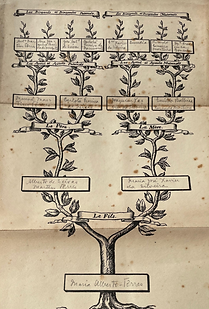
Family tree
Alberto Torres
On January 11, 1985, at the Alcântara health center, in São Gonçalo city, Maria Alberto Torres died of complications from diabetes.